
From Survival to Resource Allocation: The Silica–Minerals–Vitamin C Hypothesis
Why Triage Theory May Explain Patterns of Cellular Maintenance
In the three years since I launched PureRadiance Hair Revive, I’ve noticed a consistent pattern: within 90 days, users weren’t just reporting “better hair”—many described a visible shift in hair density, improvements in texture and tone, a more resilient skin appearance, and a broader sense of increased vitality.
As a founder, I wanted to move beyond the “magic pill” narrative and look more closely at the underlying biology. Our hypothesis bridges Dr. Bruce Ames’ Triage Theory (published in PNAS, 2006) with known principles of cellular signaling and nutrient allocation.
These recurring, multi-system changes led us to explore whether these patterns reflected how the body prioritizes its biological budget under different nutritional conditions.
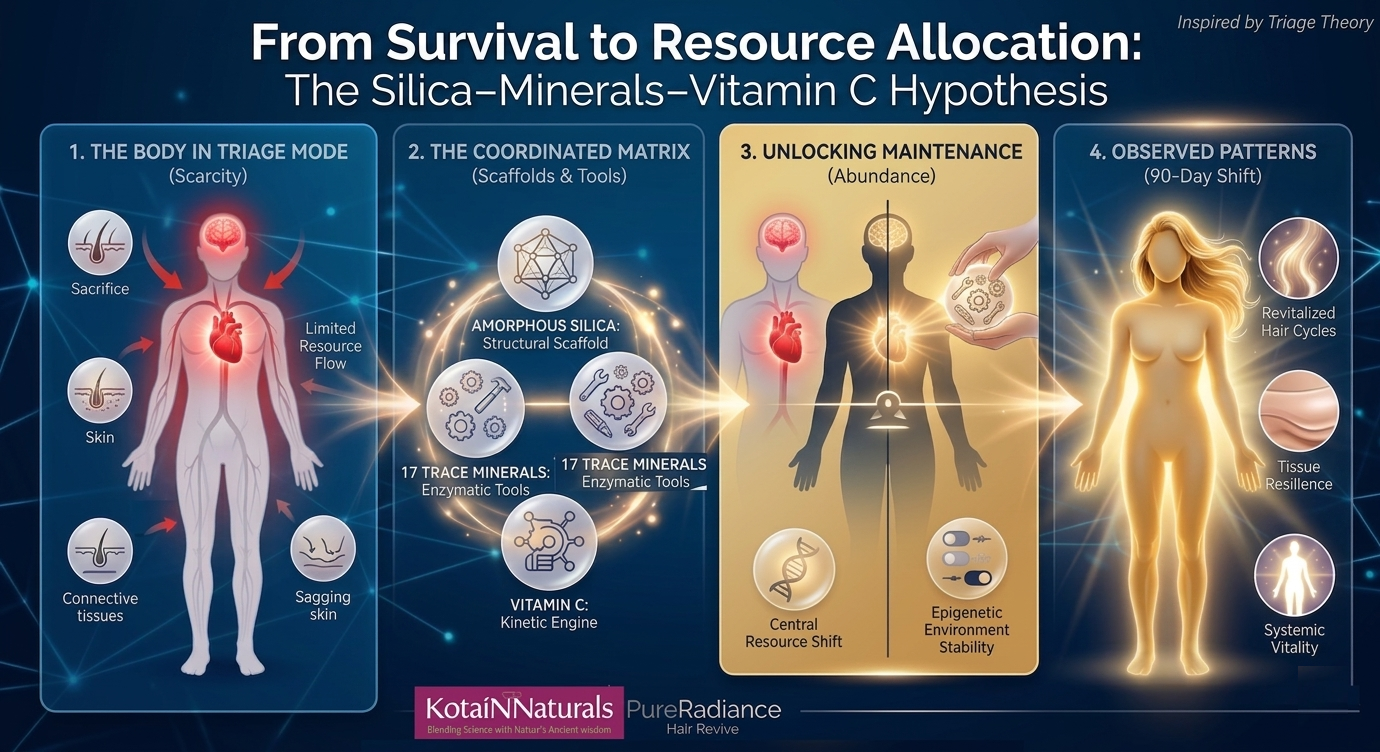
1. The Triage Effect: Why Signs of “Aging” May Appear
In biology, the body is constantly making trade-offs. When resources are limited, it prioritizes essential functions—such as heart and brain activity—over longer-term maintenance systems like skin, hair, and connective tissue.
Dr. Bruce Ames’ Triage Theory proposes that when micronutrients are scarce, the body reallocates them toward immediate survival needs while reducing support for systems involved in long-term biological maintenance.
In this model, visible changes such as thinning strands, reduced skin elasticity, or shifts in hair color may not reflect chronological age alone, but may also reflect how the body distributes limited resources. From this perspective, the hair and skin are often the first systems to lose their "funding" when the body enters a survival-priority state.
2. The Silica–Mineral–C Matrix: A Coordinated System
Our hypothesis focuses on providing the body with a coordinated environment of co-factors to support a shift away from "survival mode" and toward a maintenance-focused state.
Amorphous Silica (Structural Support Signal): Silica acts as an important component in connective tissue, helping to maintain the "scaffolding" needed for healthy tissue integrity.
17 Trace Minerals (Enzymatic Cofactors): Minerals like copper and zinc are the "tools" required for enzymes to manage antioxidant defense and tissue maintenance.
Vitamin C (Kinetic Support Factor): Essential for collagen synthesis, Vitamin C helps the body effectively utilize mineral and silica inputs.
3. The Epigenetic Environment: Nutrient Feedback
A key part of this hypothesis involves DNA methylation, a process that helps control gene expression—essentially acting as a dimmer switch for biological functions.
As we age, these "switches" can become less consistent. While we aren't claiming to "rewrite" DNA, we are exploring how nutritional abundance supports a more stable environment for gene expression. When the body has a consistent supply of what it needs, the biological feedback loop may favor maintenance and repair protocols rather than the restrictive patterns seen during nutrient scarcity.
4. A Systems View: From Constraint to Support
Rather than focusing on a single outcome, our hypothesis suggests that consistent availability of these inputs may influence how the body prioritizes its maintenance budget. Over time, this may be associated with:
Supporting the natural hair growth and pigment cycle.
Improvements in skin appearance and resilience.
Better support for the structural integrity of connective tissue.
5. Observed Patterns: The 90-Day Shift
When the body is no longer operating under perceived scarcity, it may move from a "Survival" state to a "Maintenance" state. In this context, observed user reports often describe:
A revitalized hair growth cycle and improved appearance of thickness, color and texture.
Healthier-looking skin and improved perceived firmness.
An overall shift in systemic vitality over a ~90-day period.
Key Takeaways
Triage Theory explains how the body prioritizes survival over long-term hair/skin health.
The Matrix of Silica, minerals, and Vitamin C works as a unified biological support system.
Nutrition provides the environmental feedback that allows the body to maintain its standard repair protocols.
Sources & Scientific Context
Ames, B. N. (2006). "Low micronutrient intake may accelerate the degenerative diseases of aging through allocation of scarce micronutrients by triage." Proceedings of the National Academy of Sciences
Disclaimer: This post represents a working hypothesis based on observed user outcomes and existing nutritional literature. It is intended for informational purposes only and has not been evaluated by the FDA. This product is not intended to diagnose, treat, cure, or prevent any disease. Individual results may vary
